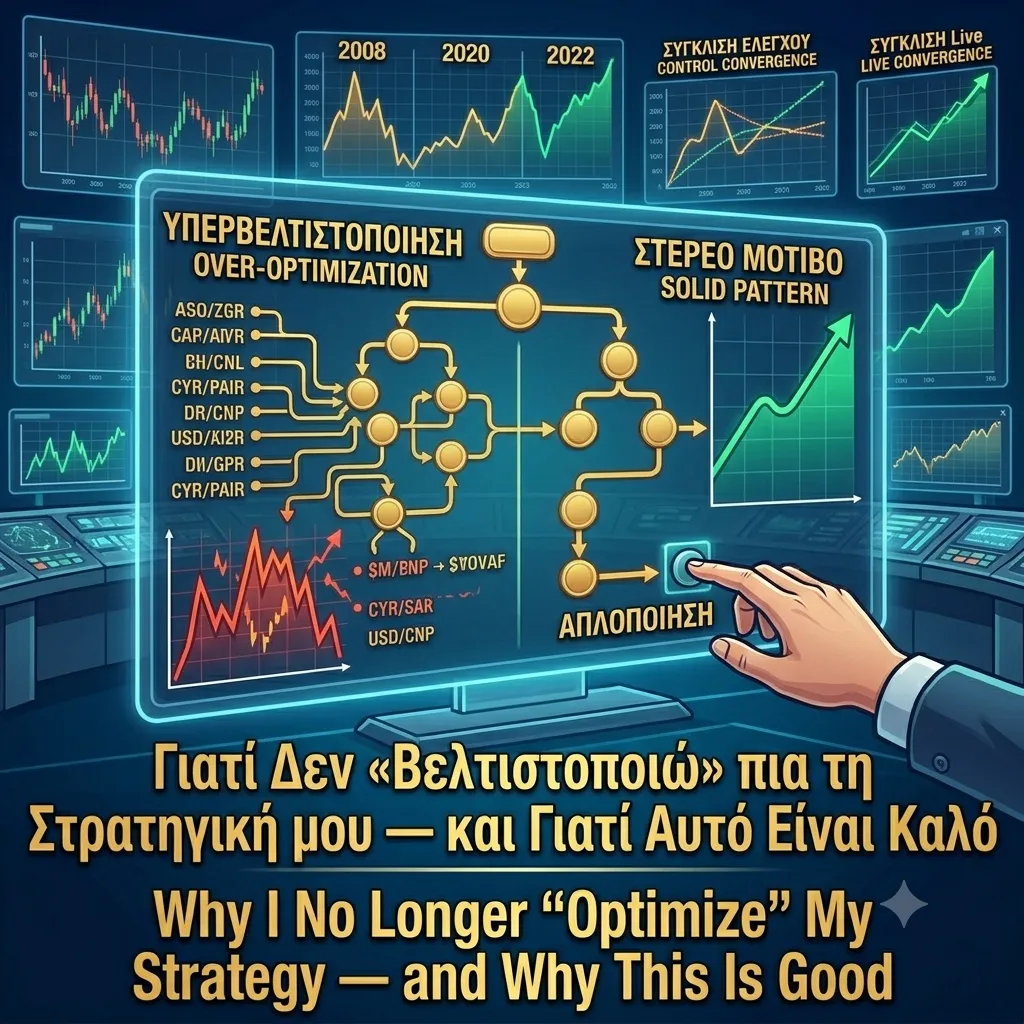
There is a deeply rooted belief in trading: that you must constantly improve your system. Adapt it to new conditions, "tweak" it, make it better. Over the years, I reached the opposite conclusion — and it was liberating.
The problem with constant optimization is that it often doesn't improve; it overfits. Every time you "fix" the strategy based on the most recent data, you adapt it to the past that just happened — and make it more fragile for the future that hasn't arrived.
A genuine statistical edge doesn't need constant "improvement." If it does, then it probably was never a real edge — it was adaptation to noise. The true pattern is structural; it works precisely because it doesn't depend on the circumstances of the moment.
This doesn't mean passivity. It means the role changes: from a creator who intervenes, to an observer who monitors. I watch whether the behavior stays within statistical limits. If it does, I touch nothing. The discipline of doing nothing is far harder than the discipline of doing.
There is a beauty in this approach. The system becomes autonomous, with predictable behavior and calibrated risk. It doesn't need "inspiration" — it needs silence and patience. And in the end, the stability that comes from leaving a good system alone is worth more than any "improvement" that would break what already works.