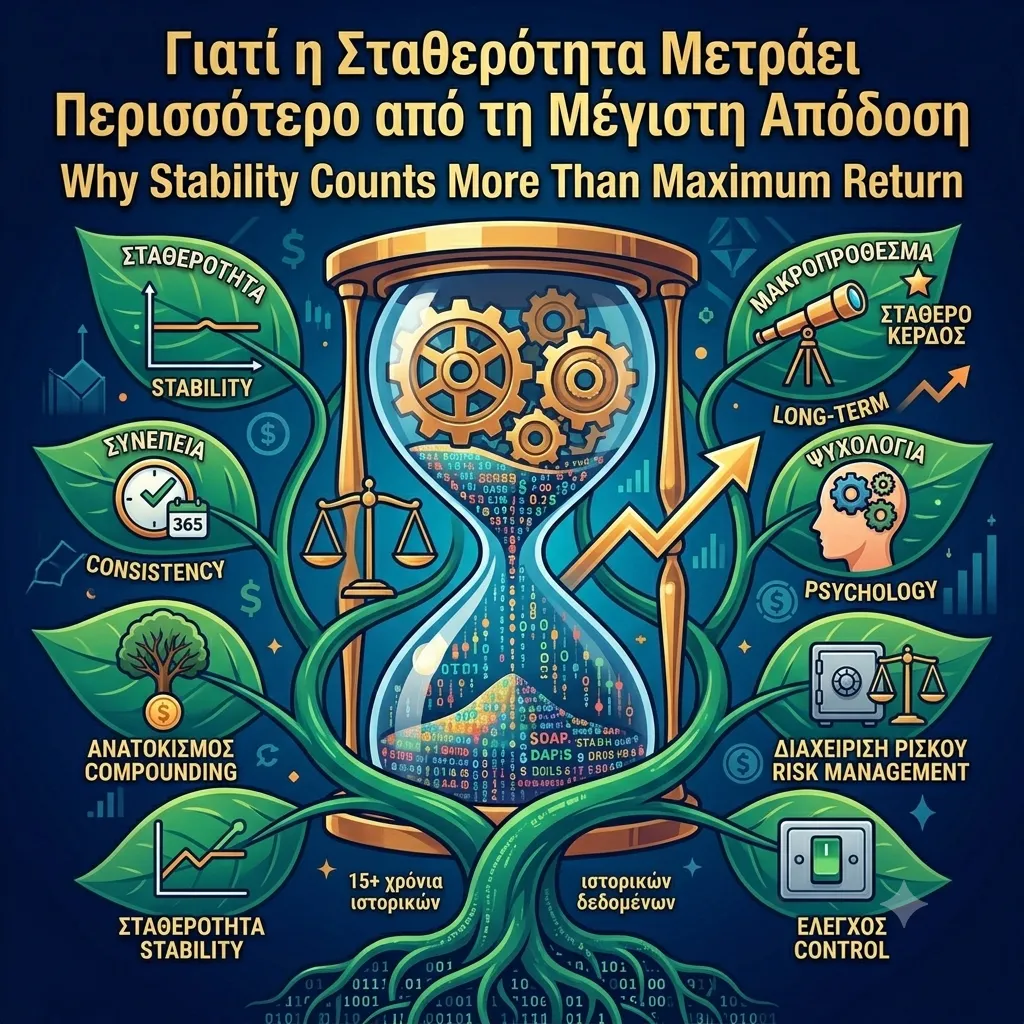
In trading there is a temptation to chase the biggest possible number. But experience — and mathematics — show that stability beats impressive but volatile returns in the long run.
The reason is compounding. A system that delivers steady, modest gains without big drops lets compounding work uninterrupted. By contrast, a volatile system that alternates huge gains with heavy losses constantly "breaks" the compounding chain.
Take two systems over 10 years. The first makes a steady +20% every year. The second makes +60% half the years and -30% the other half. At first glance, the second's average (+15%) looks comparable. But in practice, the first system ends up with dramatically more capital, because it never has to "recover" from heavy losses.
There is also the psychological dimension. A stable system is something you can hold for years without losing sleep. A volatile system, however impressive in the good periods, will sooner or later force you to give up at the worst moment.
That is why, when evaluating a strategy, don't ask "which has the biggest number?". Ask "which can I hold, with confidence, for the next ten years?". Usually it's a different answer — and the right one.