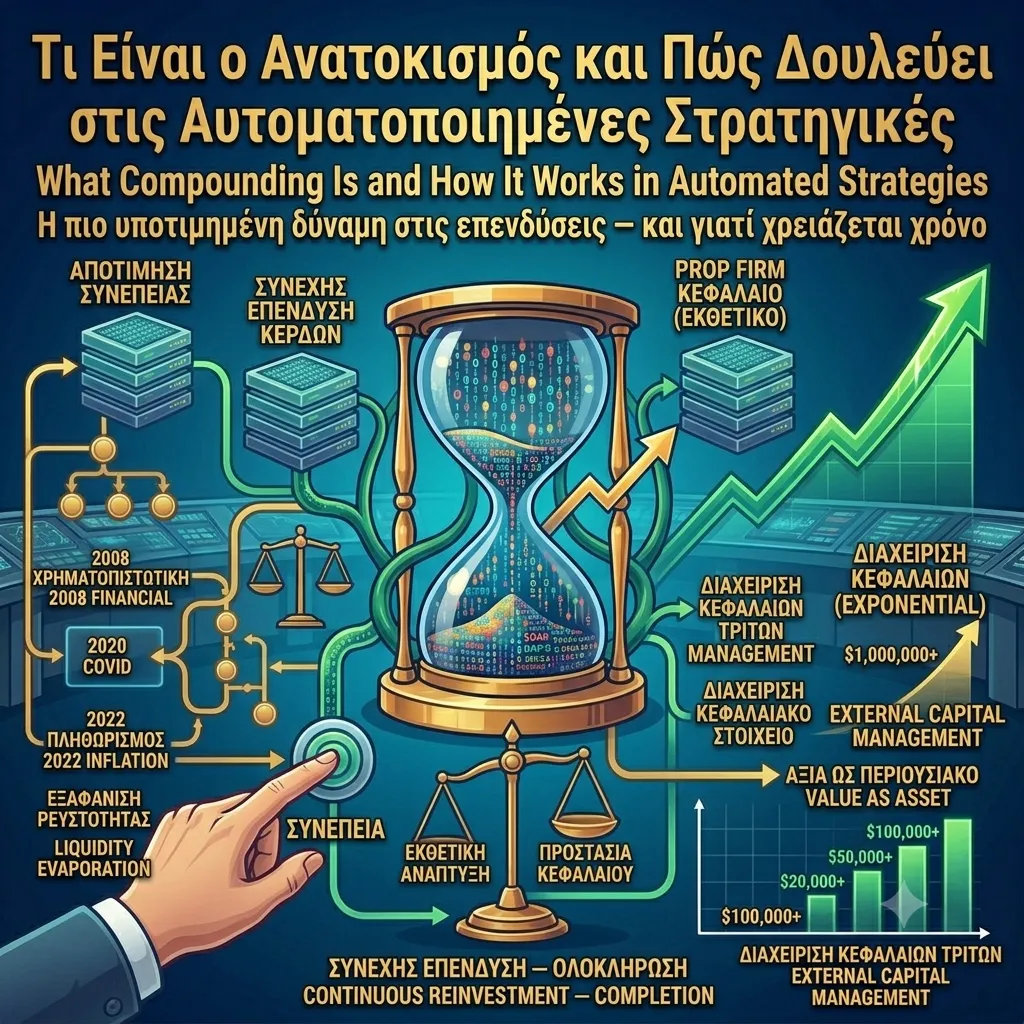
Compounding is when your profits start producing their own profits. Instead of withdrawing the profit each month, you leave it in the account; so the next profit is calculated on a larger capital.
The result is not linear — it is exponential. At first it seems slow, almost boring. But over time, the curve starts to rise steeply. Capital that grows at a steady rate for enough years can reach numbers that seem unbelievable at the start.
Take an example. An account that steadily returns around 30% per year roughly doubles every two and a half years. Over 15 years, that means many doublings in sequence — and that is where the exponential nature of compounding becomes striking.
Why does this connect to automated systems? Because compounding requires two things humans struggle to provide: consistency and patience. A system that follows rules doesn't "take its profits" out of fear, nor break the strategy during a bad period.
But there is another side. Compounding works downward just as well: a large drawdown destroys years of compounding. That is why protecting capital from catastrophic losses is not a defensive choice — it is the prerequisite for compounding to work at all.