When most people evaluate a trading strategy, the first question they ask is simple: 'How many trades does it win?' The win rate appears to be the most important metric. In reality, however, it is not enough on its own to reveal whether a strategy possesses a genuine edge.
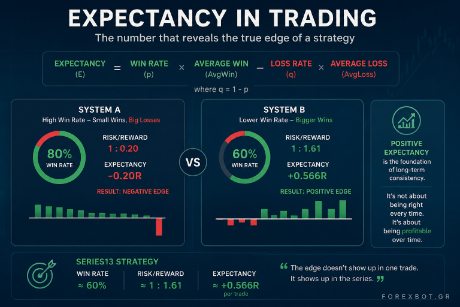
Imagine two different traders. The first wins 80% of his trades. The second wins only 60%. Most people would assume that the first trader is better. Yet the reality may be exactly the opposite.
If every losing trade of the first trader is significantly larger than his winning trades, only a few losses can erase months of gains. In contrast, the second trader may lose more frequently, but each winning trade generates substantially more profit than the amount risked.
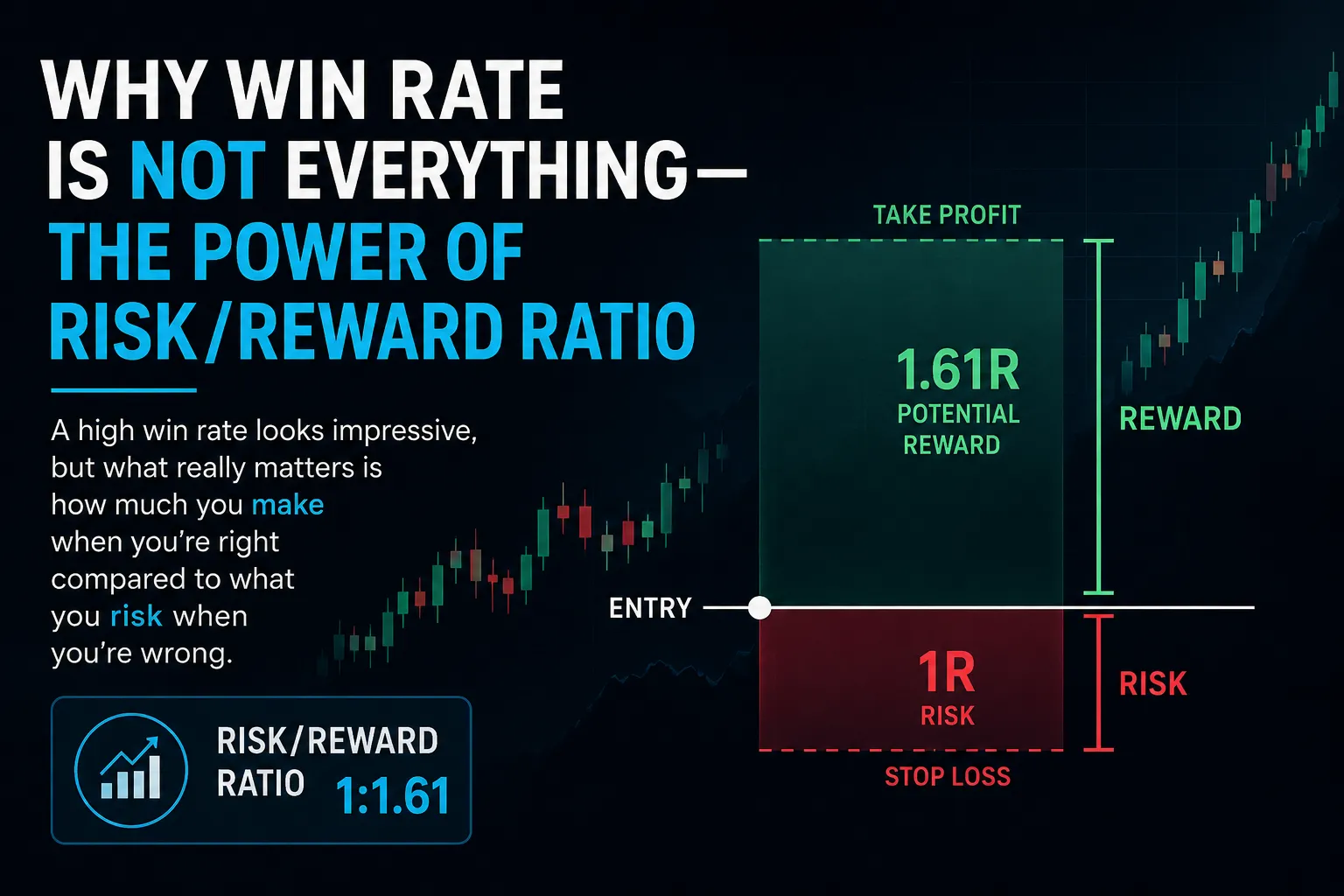
This is the essence of the Risk/Reward Ratio. It describes the relationship between the amount being risked and the potential profit of a trade. A Risk/Reward Ratio of 1:1 means the potential reward equals the risk. A Ratio of 1:2 means the potential reward is twice the amount being risked.
What makes this concept so powerful is that as the Risk/Reward Ratio improves, the win rate required for profitability decreases. A trader with an excellent Risk/Reward Ratio can remain profitable even if most of his trades end in losses.
In my own case, the strategy demonstrates an average Risk/Reward Ratio of approximately 1:1.61. This means that winning trades are, on average, significantly larger than losing trades. When combined with a win rate close to 60%, it creates a positive statistical edge.
Perhaps the most important consequence of a strong Risk/Reward Ratio is psychological. It allows a trader to accept losses as a natural part of the process. There is no need to win every trade. The objective is simply to follow the system consistently and allow the mathematics to work over time.
In the end, the market does not reward the trader who is right most often. It rewards the trader who manages the relationship between risk and reward most effectively. And that relationship is often more important than the win rate itself.