Most traders look at a strategy's win rate first. They ask: 'How many trades does it win?' It is a natural question, but often the wrong one.
A strategy can win 80% of its trades and still lose money. Another may win only 40% of its trades and yet be highly profitable. By itself, the win rate tells us very little.
What truly matters is expectancy.
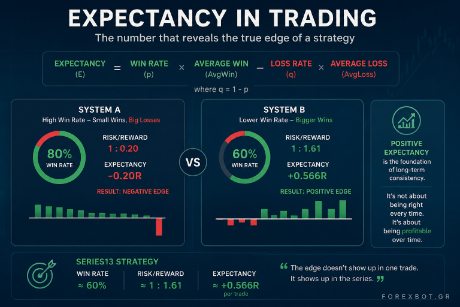
Expectancy represents the average outcome that a trade is expected to produce when a system is executed repeatedly. It is a way to condense both the win rate and the size of gains and losses into a single number.
Consider two different systems. The first wins 80% of its trades, but when it loses, it loses five times more than it typically gains. Despite the impressive win rate, the overall result may be negative.
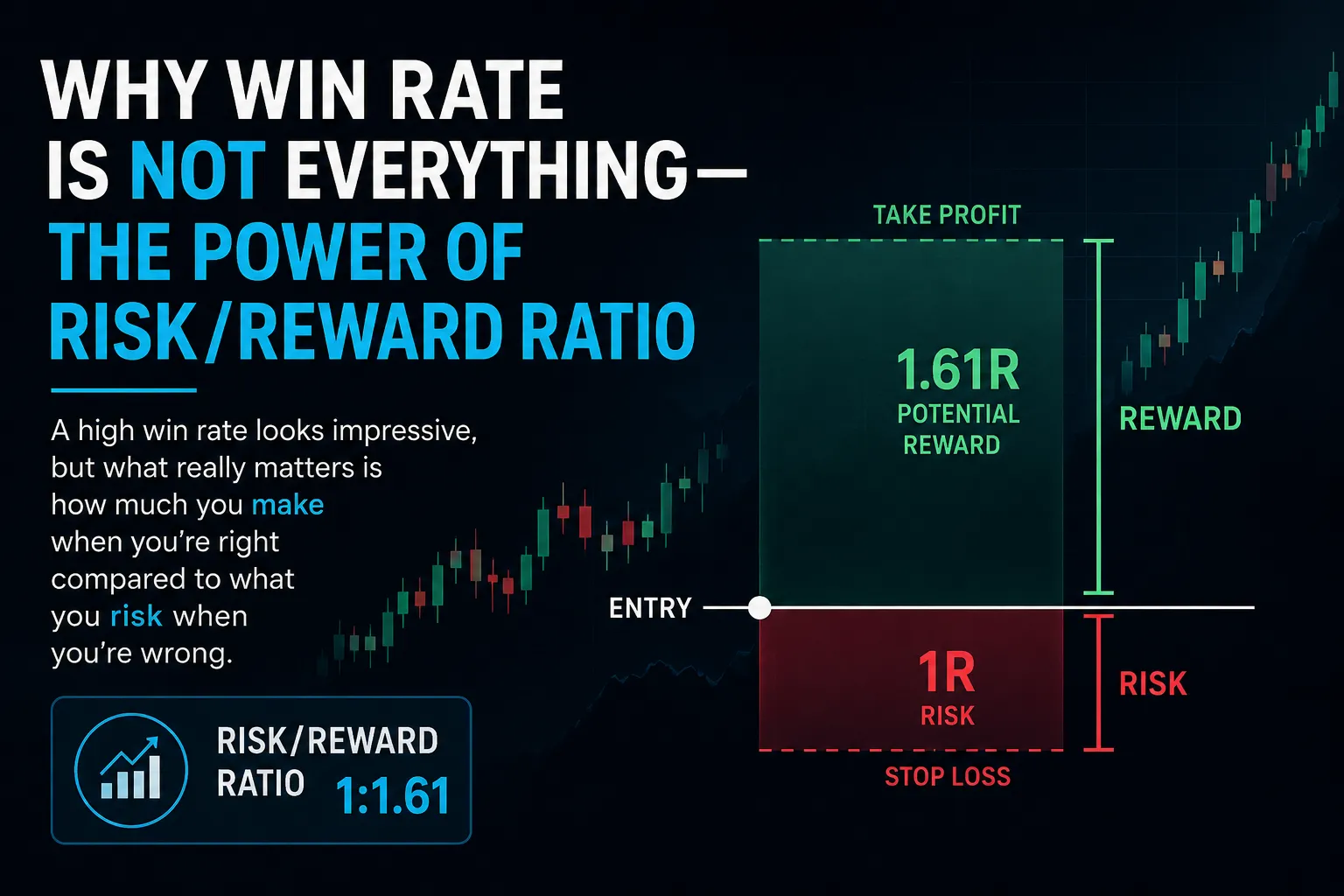
The second wins only 60% of its trades, but each winning position returns roughly 1.6 times the amount risked. Even though it loses more frequently, the overall result is positive.
This is where the power of expectancy becomes apparent. It transforms a strategy's performance from an emotional impression into a mathematical reality.
In my own case, the strategy demonstrates a win rate of approximately 60% and an average Risk/Reward ratio of about 1:1.61. This means that every unit of risk taken carries a positive expected return.
https://forexbot.gr/en/backtests-13-10 ↗
In simple terms, if a large number of trades are executed under the same conditions, the statistical edge tends to reveal itself. Not in every trade. Not in every week. But through the accumulation of many independent outcomes.
This is perhaps the most difficult concept for a trader to accept. The edge does not appear in a single trade. It appears across a series of trades.
Expectancy is a reminder that trading is not about prediction. It is about managing probabilities. And when the probabilities are in your favor, patience becomes more important than predicting the market's next move.